Evolution / Involution
Feb 3, 2026 - Mar 15, 2026
- SELECTED WORKS
- CURATORIAL NOTE
- INVITE
- PRESS RELEASE
- DOWNLOAD CATALOGUE
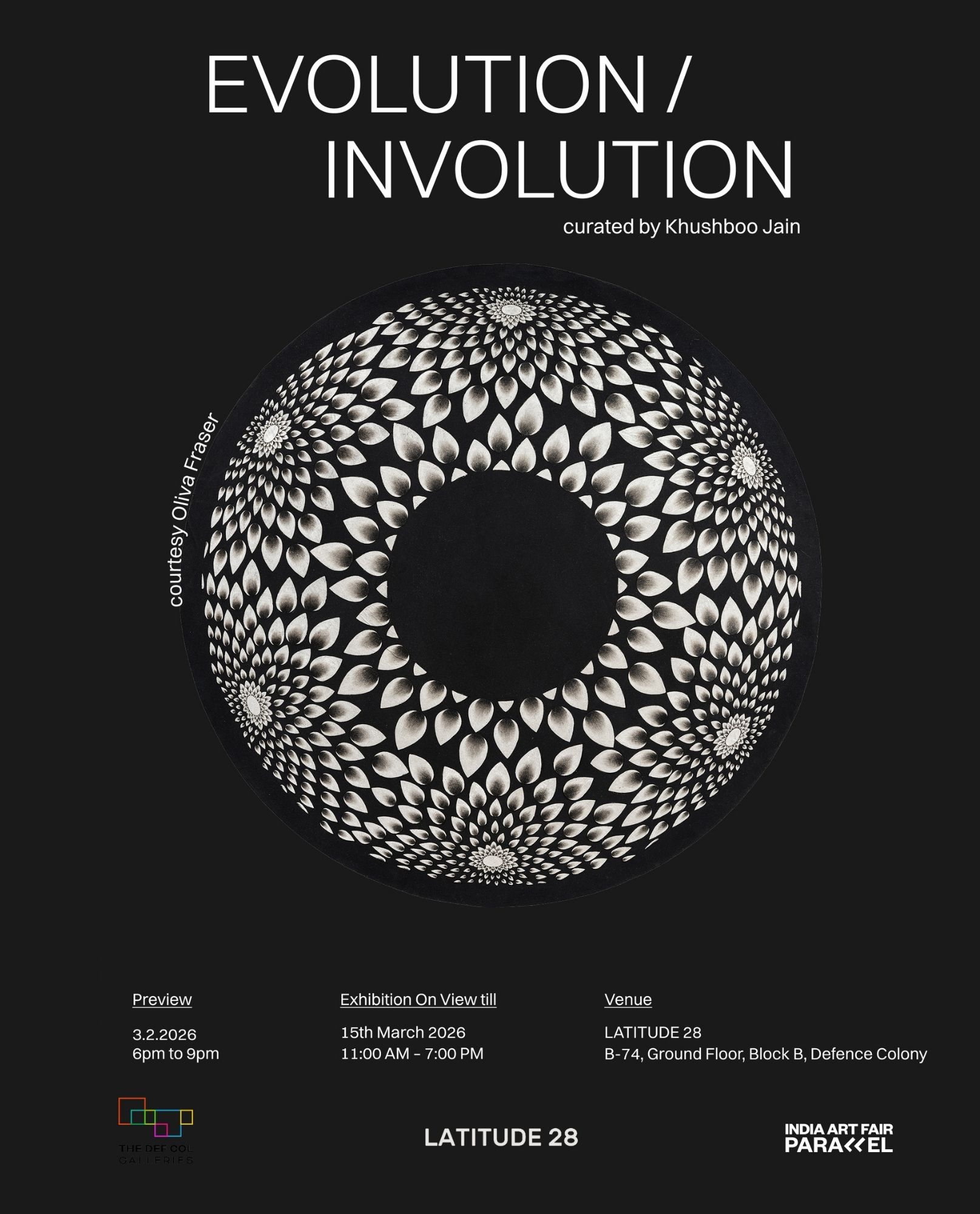
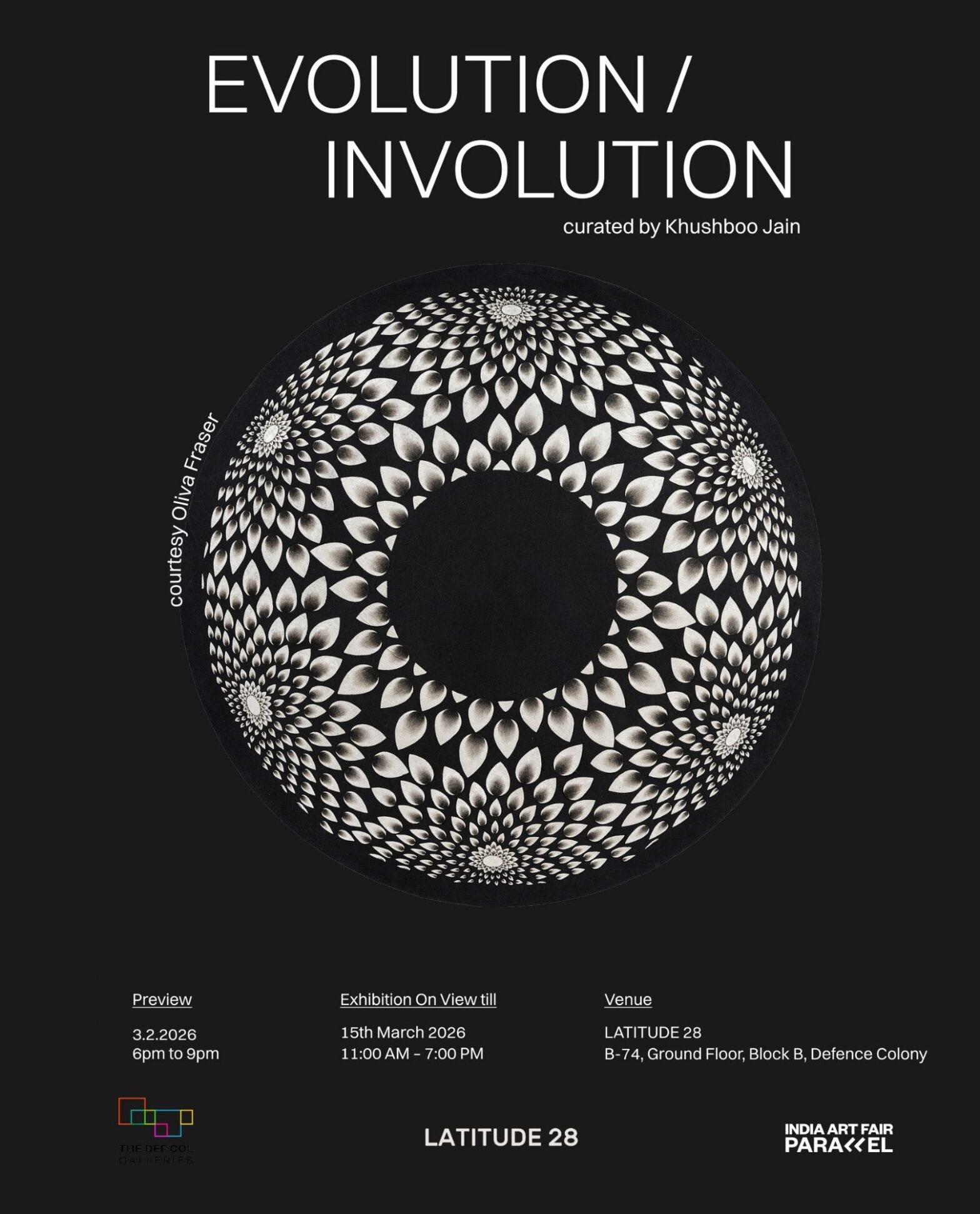
Evolution / Involution
Curated by Khushboo Jain
Consider a single note, floating in space.
What happens if one breaks it down further—the note into vibration, the vibration reduced to a point, the point held as a Bindu? These graphic notations—circles, points, grids, and pulsating geometries—are not merely formal devices. They are propositions: ways of thinking, sensing, and entering states of inwardness. In visual terms, this anatomy is shaped through repetition, movement, and focus, where form evolves, gathers, and returns to a point.
Alexander Gorlizki | Ayushi Patni | Balan Nambiar | Claudia Wieser | Desmond Lazaro | Elisa Deane | Genevieve Chua | Jethro Buck | Karen Köhler | Mahirwan Mamtani | Nicole Frobush | Olivia Fraser | Prabhakar Barwe | Shane Drinkwater | Sohan Qadri | Shobha Broota | Tanya Johnson
CURATORIAL NOTE
Consider a single note, floating in space.
What happens if one breaks it down further—the note into vibration, the vibration reduced to a point, the point held as a Bindu? These graphic notations—circles, points, grids, and pulsating geometries—are not merely formal devices. They are propositions: ways of thinking, sensing, and entering states of inwardness. In visual terms, this anatomy is shaped through repetition, movement, and focus, where form evolves, gathers, and returns to a point.
This mode of working takes shape within a significant post-1960s movement in Indian modern art, when abstraction became a site of renewed enquiry rather than stylistic alignment. For a number of artists, reduced geometries and restrained palettes offered a way to think through form without recourse to narrative or representation that functioned as visual pathways to meditation, attunement, and the dissolution of binaries. Central to this inquiry is the Bindu, not as a symbol, but as an organising principle: a point of origin, tension, and return.
This profound turn towards inwardness was propelled by a critical realisation among artists of the 1960s and 1970s. While the Bindu sits at the core structures of tantric cosmology and philosophical order, it was approached simply as an iconography, but as a mode of ‘knowing’ that translated into form through a deep, individual thought process. This translation became urgent due to encounters with dominant western modernist languages, many of which carried a residue of colonial impositions/ hierarchies, highlighting the limits of the tantric iconography and its abstraction grounded solely in external paradigms. Movements such as Cubism, Expressionism, and Constructivism revealed the limitations of abstraction grounded purely in external form, underscoring the absence of pluralistic philosophy. Thus, the artist began to retreat deliberately, in search for structuring this very understanding that could hold both thought and sensation. Turning inward, therefore, became a way for the artistic agency to articulate concentration, return, and internal coherence through a distinctly nuanced, layered and internal conceptual framework. For many artists, in their search for a personal artistic mantra and distinct grammar, Tantric artistic practices emerged not only as revivalism, but also as a necessity for self-exploration and a culturally grounded response to exoticisation. Within this context, the ‘Bindu’ offered a rigorous mode of ‘knowing’ translated into form, rather than a belief system to be illustrated.
Such interiorised systems, including the idea from which the ‘Bindu’ derives, had long been marginalised within colonial and early modernist frameworks, dismissed as irrational, or pre-modern. Even within Indian cultural discourse, they were often relegated to the occult or the fringe, complicating the reception of artists who critically engaged with these visual languages. To work with the Bindu through abstraction was therefore a decisive act: a refusal of inherited hierarchies and an assertion that inwardness itself could legitimately organise modern visual language.
This engagement with the Bindu, rooted in tantric ways of knowing yet articulated through contemporary abstraction, continues in the present exhibition. Here, artists move beyond expressionist strategies toward a more concentrated, receptive, and resonant visual language, rendering the Bindu as a potent artistic and intellectual proposition rather than a symbolic motif. It further proposes a shift in how these lineages are understood today. In this context, the note as inscribed as the Bindu functions as a generative tool: a structural spine through which multiplicity unfolds and collapses, offering ways to negotiate the psychic, spiritual, and material tensions of contemporary life—what Stella Kramrisch described as “the metaphysical hunger of modern man.”
While anchored in South Asian visual and philosophical lineages, the exhibition remains transnational and cross-disciplinary in its outlook. It brings artists from global spheres who answer enduring questions about the relationship between Tantra and contemporary Indian art—questions that move beyond iconography toward method, discipline, and inner orientation. This creates a collective document of how Tantric philosophy and practice informed the evolution of abstraction in India.
Ultimately, it asks: what if the very cultural forms of knowledge once objectified or marginalised could be reclaimed as tools for freedom—capable of dismantling rigid ways of seeing and opening new possibilities for perception, agency, and redefinition?
“In the beginning was the Bindu—unmanifest, silent, and absolute. From it unfolds the entire rhythm of the cosmos.”
Art of Nuance – something, everything, or no-thing
Prof (Dr.) Madhu Khanna
The world is passing through an era of darkness and dystopia, marked by unprecedented challenges across every sphere of life: environmental degradation; socio-political, economic, cultural, and communal conflicts; growing inequality, injustice, and social divides; and threats posed by the unethical use of AI and technology. Individuals experience irreparable psychological loneliness and angst, driven by a materialistic philosophy that permeates our value system—one governed by individualism, consumerism, and egocentric choices. This system lacks a meaningful code for understanding the soul or authentic self. Amidst such historical uncertainties, art-making—honed by the artist’s creative spirit—has sought non- invasive ways to express and reinvent works. These works illuminate paths toward a human utopia. Unlike ChatGPT, which cannot penetrate the depths of the soul or the truth of revelation, art and artistic expression expand the self’s imaginative boundaries.
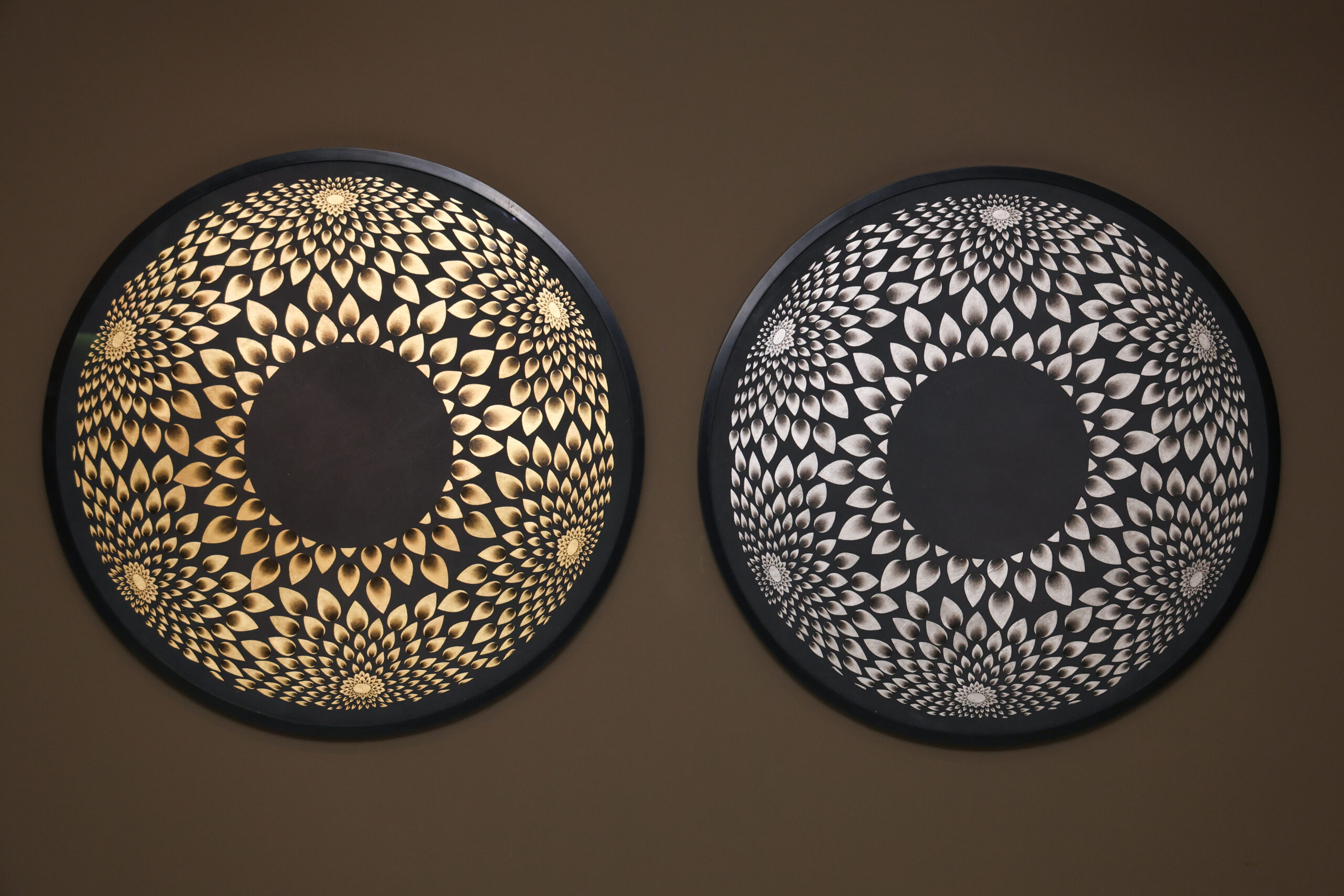
The exhibition ‘Evolution/ Involution’ understood the potential of the archetype, the Bindu—a universal symbol of Tantric philosophy and minimal art. The Bindu veils multiple possibilities of expression. The dimensionless point, though invisible to the eye, is not a static symbol. It is a dynamic, vibrating, generating symbol of consciousness, concealing immense creative potential. Shobha Broota and Jethro Buck recall the image’s universality in their respective works. The Bindu is the sign that presages the potential waves of creation. It is identified with the image of a centred consciousness.
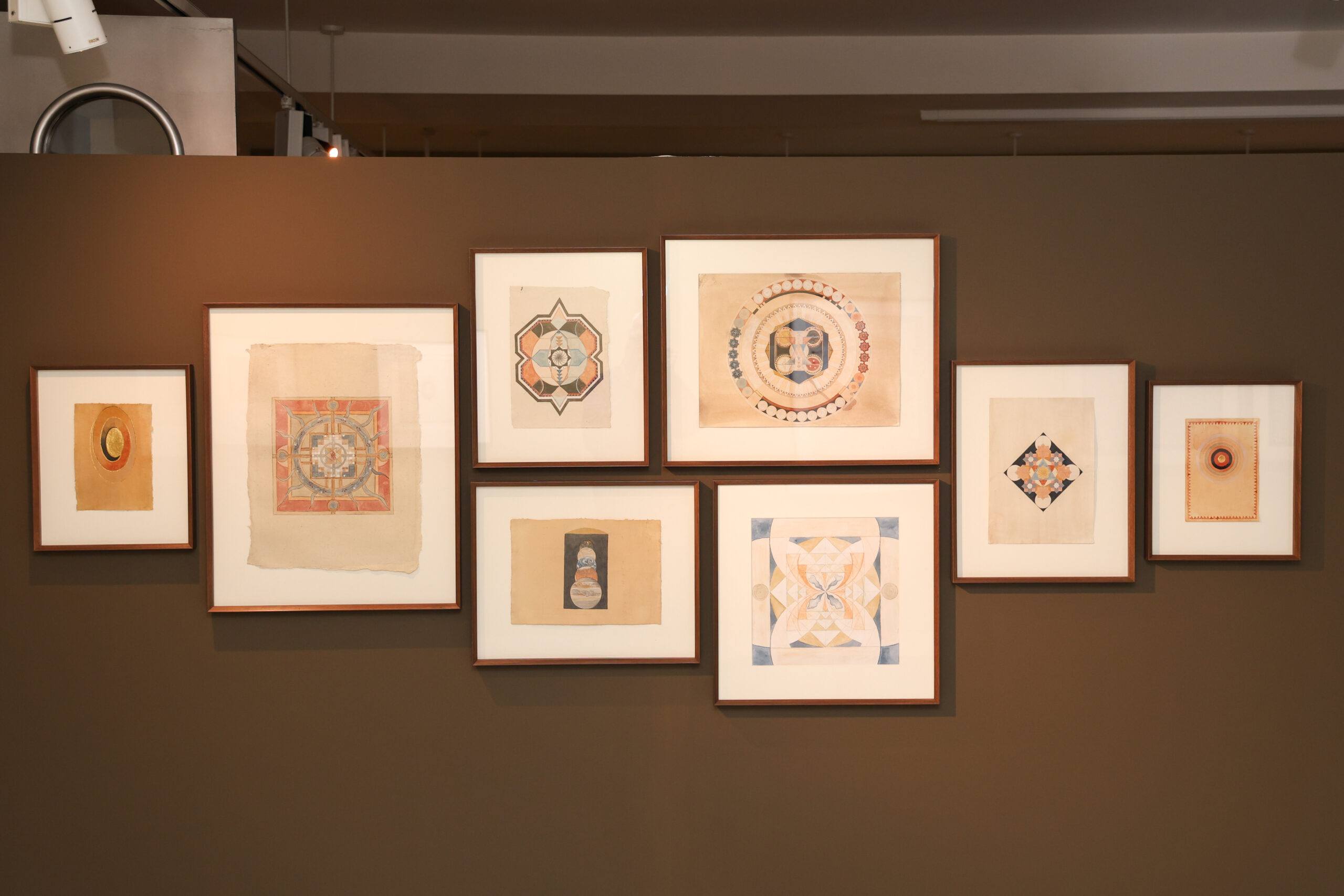
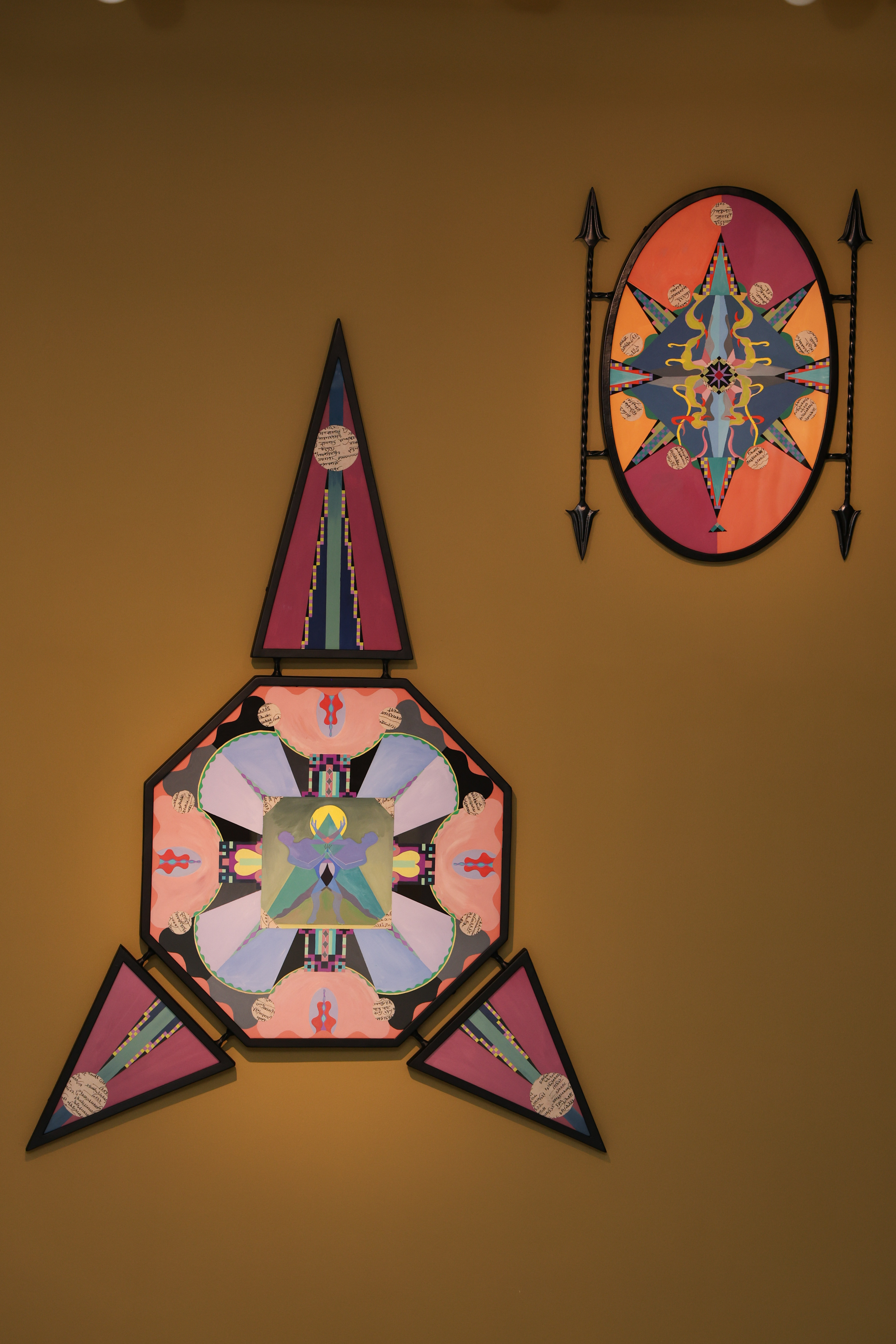
The eclectic collection showcases works by 17 international artists. United by inspiration from the quiet wonder of Tantra-yoga-abstraction in sacred art, the artists employ a variety of approaches. Ayushi Patni, from India contributes layered crafted collages, while Tanya Johnson, from Canada and Balan Nambair, from India creates architectonic rhythms of structural patterns through 3D sculptural circuits that form vertical or circular mandalas. Prabhakar Barwe’s tantra-inspired designs evoke the drum-shaped damru of Shiva, originating from a red bindu. Nicole Frobush and Alexander Gorlizki, from the UK, experiment with archetypal language. Shane Drinkwater, from Australia, brings ancient dreamtime landscapes that transport viewers to the heart of creation. Desmond Lazaro, from the UK, expands artistic boundaries beyond the miniature, while Elisa Deane, from the UK, does the opposite, compressing Islamic spirituality into a frame within miniature paintings. Chua’s (from Singapore) disappearing moon spirals open a perceptible circular window that holds hidden, bursting energy.
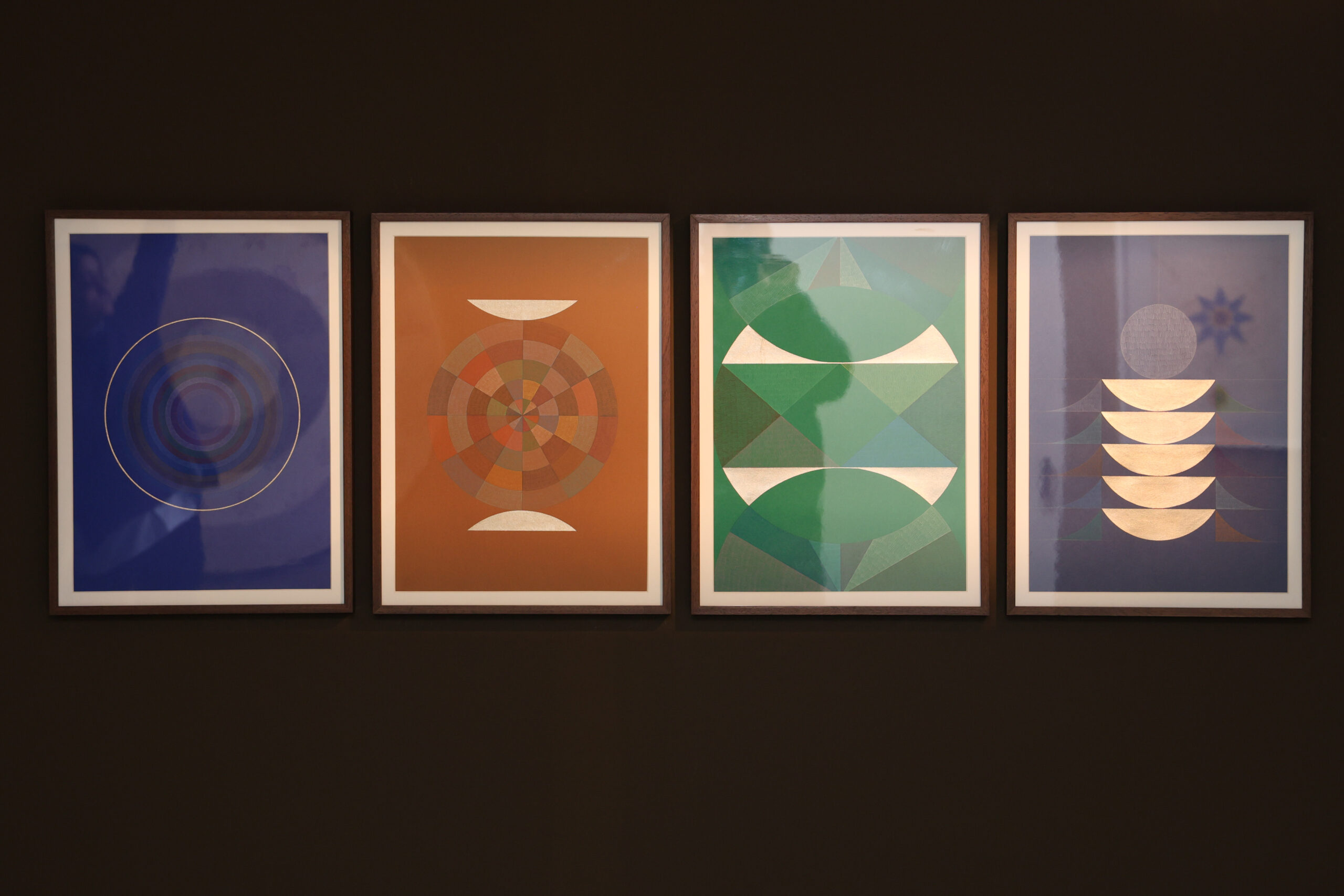
In contrast, Jethro Buck paints a visual poem of the natural landscape using the soft- brush technique of miniature painting. Karen Kohler, from Germany, is inspired by geometrical centrifugal forms in vivid colours, reflecting the theme: ‘Seed your soul to look for a seed within.’ Mahirwan Mamtani (Germany), Olivia Frazer, and Elizabeth Deane focus inward to create geometrical configurations that suggest atomic cosmometric forms underlying creation. Viewed in isolation or together, the exhibition presents a nuanced expression of something, everything, or a void, an absence, or a paring away of the unnecessary.
No-thing aligns with many minimal signs of the sacred familiar to us. We can assume these expressions emerge from the deep structure of the trillions of neural lattices in the human brain, reflecting the common ground of our creative potential. Art offers a non-invasive means to address the challenges facing our divided psyche. These artworks present a coherent vision—one that transcends nationality, ethnicity, and religion—rooted in the sacredness of wholeness and a refined aesthetic sensibility. We must reflect on which forms of art can foster conscious self- transformation. Such shapes influence our awareness and encourage integration in today’s fragmented world.
INSTALLATION VIEWS