Mihika Poddar
2003
Mihika Poddar’s practice engages the psychological terrain where memory, folklore, fear, and desire intersect. Working across painting, drawing, sculpture, and mixed media, her works function as constructed worlds in which the boundaries between the conscious and unconscious become increasingly unstable. Drawing upon psychoanalytic frameworks, cinematic horror, and mythic narratives, she approaches horror not as a genre but as a methodology through which repressed emotions, inherited anxieties, and unresolved psychic states can be examined. Through this, her practice investigates the shifting relationship between vulnerability and agency, tracing how formative fears are transformed across time.
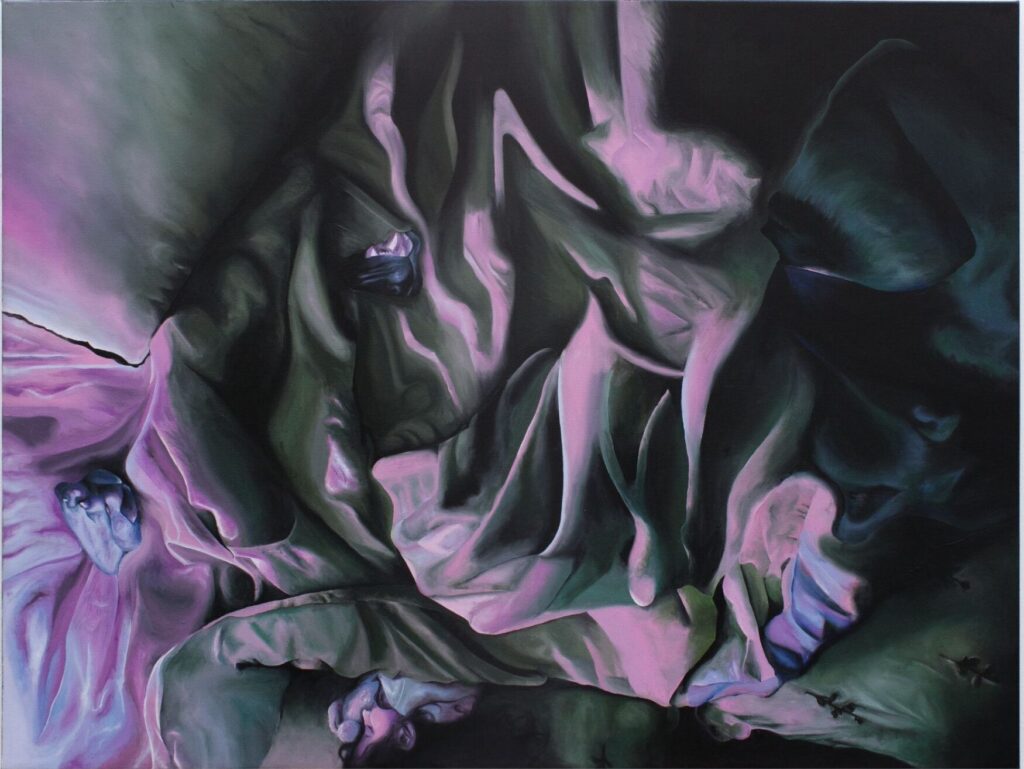
Central to Poddar’s work is the figure of the monster as a site of psychological projection and self-recognition. Recurring motifs such as bedsheets that entangle and conceal, disembodied hands that reach or recoil, and figures suspended between revelation and obscurity articulate tensions between intimacy and unease. Drawing from the visual drama of Baroque painting, she employs saturated colour, theatrical light, and layered surfaces to construct emotionally charged spaces where attraction and repulsion coexist. Folkloric figures, particularly Habu, a childhood monster associated with discipline and obedience, are reimagined as symbols of the repressed self. Through these transformations, the monstrous emerges not as an external threat but as a force through which desire, autonomy, and selfhood are negotiated.
Poddar received her Bachelor of Fine Arts from Parsons School of Design, New York. Her work has been included in exhibitions such as Summer Solstice and Concrete Myths at Van Der Plas Gallery, New York (2025), and has been featured in publications including Divide Magazine and Curatory Magazine.
Poddar lives and works in New York City, United States.